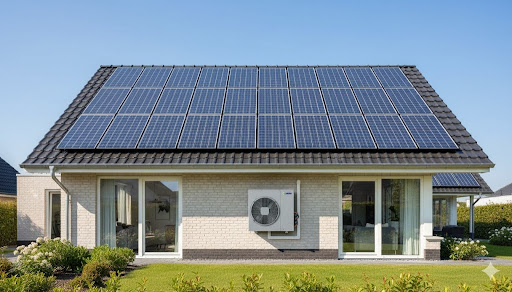
Solar Panels with an Air Source Heat Pump
Homeowners in the UK are showing a steady interest in environmentally friendly means to heat their residences. Air source heat pumps and solar panels are two of the most common methods; both are capable of cutting down on energy expenses and reducing your carbon footprint.
The question is, are solar panels and an air source heat pump compatible? The answer is “indeed!”. The combination offers a very efficient and eco-friendly heating system; let us go into the details of this combination and the merits of considering the same.
Why Use an Air Source Heat Pump?
The outside air is at a temperature that is higher than that of the ground in winter, so a heat pump extracts this, and thus, it is called an air source heat pump (ASHP). The system provides heat and hot water to meet the household’s needs during periods of very low temperatures. This system involves the use of an electric heater, since a gas or oil boiler is not permitted. Therefore, ASHPs burn less fossil fuel and consequently have lower carbon emissions.
Further, it is a step towards the elimination of fossil fuel consumption. United Kingdom homeowners choose ASHPs because they not only allow them to utilize less energy but also lower the cost of energy bills. It may prove to be a wise investment for your property after a period of time. However, the operating costs of ASHP depend on the electricity rates, as they consume electricity. This makes solar power a perfect partner.
Compatibility of Voltage and Wattage of ASHP with Solar Panels
Electricity is consumed by air-source heat pumps to operate their compressors and fan units. Generally, they consume around 1 to 3 kWh every hour. The actual wattage is dependent upon the size of the pump and the property. A typical domestic ASHP runs on a standard 230-volt single-phase supply. This makes it fully compatible with household solar power systems in the UK.
On the other hand, the main source of the production of electricity by solar panels is sunlight. Each solar panel can give power from 250 to 400 watts. About 3 to 6 kWh per hour is the approximate generation capacity of a complete solar array. This output can easily match the energy needs of an ASHP. The heat pump of solar energy, when the panels generate sufficient electricity.
That is, the pump can warm your home without drawing energy from the grid. Even the sunny days are capable of the panels producing extra electricity. This excess energy is then banked for later use in batteries. It is this stored energy that keeps the system running during the night or cloudy days.
Proper system sizing is necessary to ensure compatibility. The solar panels should produce enough power for the pump and household use. An installer will calculate your home’s energy demand before installation.
They’ll also check the heat pump’s starting current and voltage stability. This ensures the solar system provides enough steady electricity. In most UK homes, a 4 kW solar system pairs perfectly with an ASHP. This setup will reduce your electricity bills by up to 60%. It will also ensure that your heating is green throughout the year.
How Much Will It Cost to Combine ASHP with Solar Panels?
Combining both systems is more expensive upfront, with the possibility of long-term savings. The average price for an air source heat pump ranges from £7,000 to £13,000. A standard solar panel system, with 4 kW, costs somewhere in the region of £5,000 to £8,000. You can install both at once for total costs that might reach £12,000 to £20,000 inclusive. The price covers installation, labour, and equipment.
Precise costs depend on the size of your home and energy demand. It also varies based on the brand and efficiency of the systems. Adding battery storage may add an extra £2,000-£4,000 to your price. However, this combination pays for itself quickly over time. The savings on electricity and heating bills may become substantial. You could save £700-£1,000 every year. Energy prices in the UK grow year after year. Generating your own electricity protects you from future price hikes.
The combination raises the value of your property, as most homebuyers nowadays opt for energy-efficient homes with renewable systems. That makes your home more attractive if you want to sell in the future. So, although the cost at the start is high, the long-term benefits are huge, and the government is offering help if one cannot afford the cost.
What if a Homeowner Cannot Afford?
Not every homeowner can afford the upfront installation cost. Thankfully, there are government schemes that can help. One such scheme is the ECO4 grant. It helps low-income and vulnerable households across the UK. The Heat Pump Grant can cover the full cost of installing the heat pump. It can also help with solar panel installation in some cases.
The ECO4 scheme is part of the government’s Energy Company Obligation. It helps reduce carbon emissions and fuel poverty in homes. If you receive qualifying benefits, you may get both systems for free. This includes benefits like Pension Credit, Universal Credit, or Child Tax Credit. Even if you do not receive benefits, you may still qualify under LA Flex. This is a way local authorities can approve grants based on health or income factors.
With ECO4 funding, your home can become energy-efficient without paying up front. Accredited installers will survey your home and handle everything. They are going to install the air source heat pump and connect it to solar panels. This way, your heating system will work efficiently throughout the year. It will also help you save more on energy bills and lead a sustainable life.
If you are not sure whether you are eligible or not, just call an approved ECO4 installer who’s able to check whether you qualify and take you through the application and installation process. It is a great opportunity to upgrade your home with no cost involved.
Conclusion
Combining solar panels with an air source heat pump is a smart choice. It gives you free, renewable power to run your heating system, reducing energy bills and carbon footprint all at once. Both systems work well together as their voltage and wattage are compatible. You can heat your home and power your appliances efficiently.
Admittedly, it can be expensive, but it is worth the investment. Under certain government schemes like ECO4 Scheme, you may not need to pay for it. That would mean a greener, warmer, and more comfortable home without costing you a dime. Therefore, if your objective is to save bills while protecting the environment, pairing solar panels with an air source heat pump would be a perfect step in that direction.
About the Author